Wednesday, July 29, 2015

New Orleans Maafa Commemoration July 4, 2015


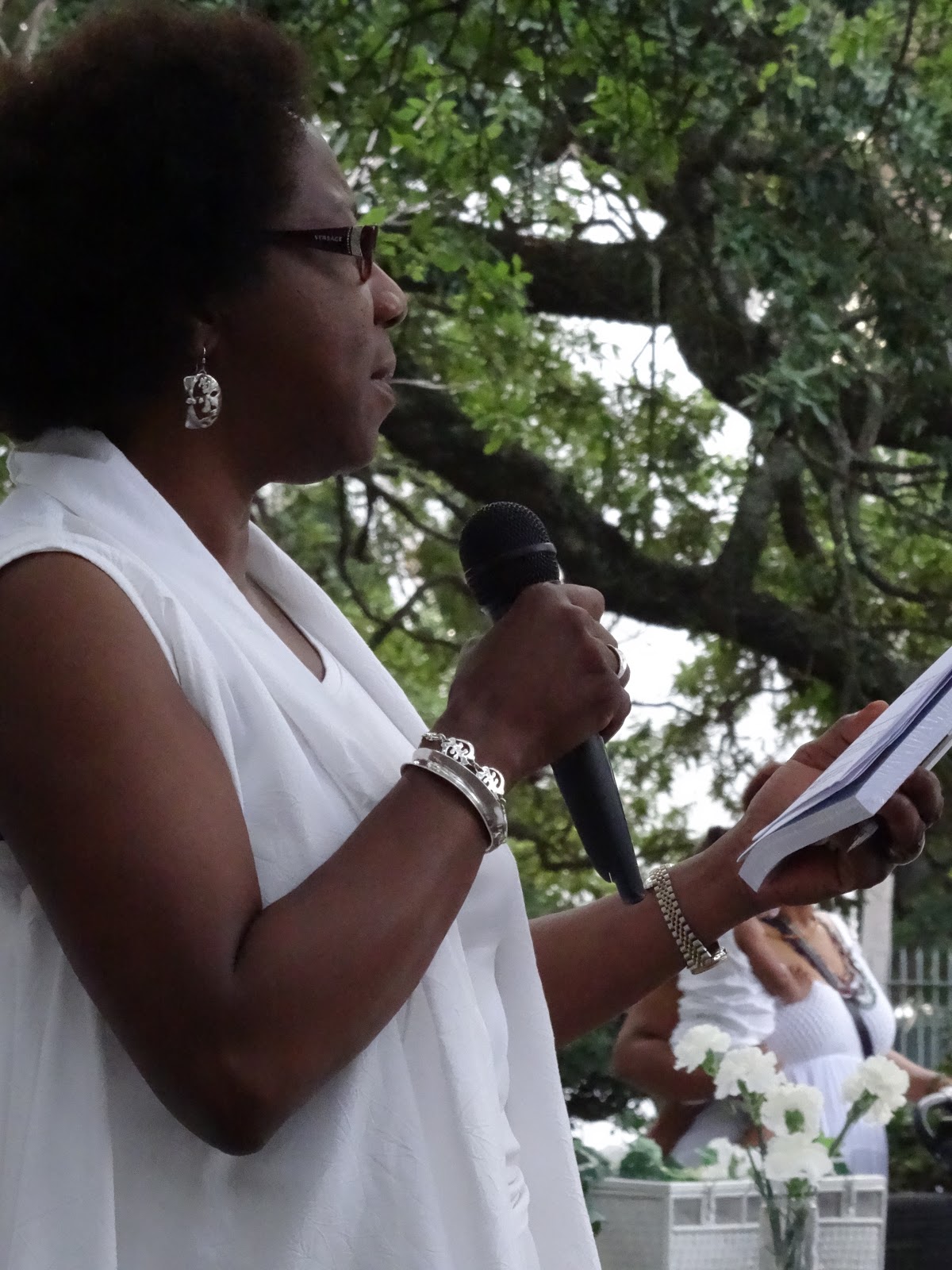
Carol Bebelle, Co-founder, Director, Aché Cultural Center, seated with Elder


Freddi W. Evans, author, Congo Square

Sakura Kone with poet, Oracle
Healing Energies from the planet
Shkt. Hrimgalah, Ausar Auset Society, SW Region
Maafa Commemoration at Armstrong Park, July 4, 2015

Fr. Maurice Nutt, Xavier University
(Baba Luther Gray)
Chief Warhorse, Choctaw Nation
Chief Clarence Delcour, Creole Osceolas with Serenity Peace Pigeon
Maafa  Commemoration@ Armstrong Park
Father holds child so she can see the Serenity Peace Pigeon
Chief Clarence Delcour, Creole Osceolas with Serenity Peace Pigeon
Big Queen Cherise Harrison Nelson with Carol Bebelle and Elder


Maafa Commemoration at Armstrong Park, July 4, 2015
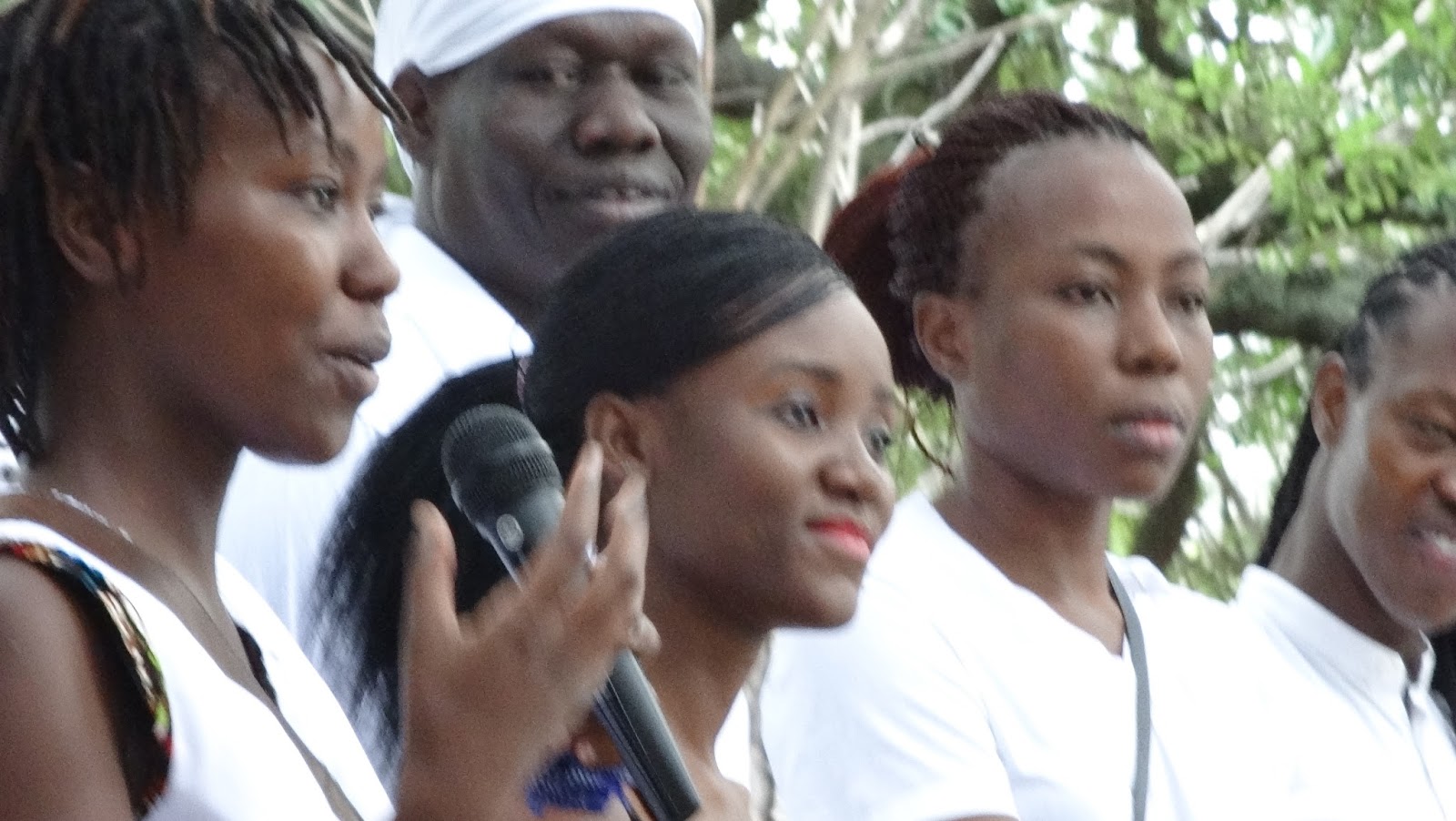
President Obama's Washington Fellows for Young African Leadership
Mama Millie Charles, MSW (far left) (91)
Ms. Charles started the MSW program at Southern Univ. New Orleans
President Obama's Washington Fellow Honors the Ancestors at Armstrong Park, as she does in Lagos
Nubian Messengers Collective, Brooklyn, NY
Zion Trinity pours libations
Children as closest to the Ancestors

Carol Bebelle (R), Co-founder, Director, Aché Cultural Center with friend from
Selma who founded the African Diaspora Museum
Maafa Commemoration @ Congo Square
Carol Bebelle, Co-founder Director, Aché Cultural Arts Center
Carol Bebelle with friend from Selma
Child watches Serenity Birds fly off at Maafa Commemoration in Congo Square
Sister Kiss: Carol Bebelle and Rev. Denise Graves
Zion Trinity
Quess (poet) shares a story
Rev. Denise Graves offers a prayer at the Maafa Commemoration
@ Armstrong Park
Sister from Selma celebrates the Ancestors
Wood (Aché) speaks to a sister at Maafa Commemoration @ Armstrong Park
Carol Bebelle with museum curator from Selma
Sister from Selma shares a few words
Quess
Buddhist Prayer
Somersaults for the Ancestors


President Obama Fellow from South Africa


"The Procession to the River" from Congo Square at Maafa Commemoration in NOLA, July 4, 2015

Maafa Commemoration in NOLA, Procession to the River

FiYiYi & N'Fungola Sibo West African Dance Troupe at
Maafa Commemoration NOLA 2015

Black Nuns in NOLA

Big Chief in Maafa Commemoration Procession


Rev. Denise Graves


Mrs. Neville and her daughter, Liryca Neville at Robert E. Lee Circle
where the Confederate Flag was burned. #Black Lives Matter!


Heal-Hers


Baba Luther and a member of the procession take dance-pause

FiYiYi & N'Fungola Sibo West African Dance Troupe at
Maafa Commemoration NOLA 2015

Hidden History Tour Leader @ Slave Exchange


Drum Dance Interlude

Big Chief and Sister from Selma under a tree at Tomb of the Unknown Slave at St. Augustine Catholic Church

Maafa Commemoration Procession to the River

Dad gives her a lift along the way to the River

Black History

Maafa Commemoration Procession to the River

Procession to the River
FiYiYi & N'Fungola Sibo West African Dance Troupe at
Maafa Commemoration NOLA 2015
Chief Warhorse and Heal-Her
Let us pray
The men pray for peace and release a sacred bird
Ashay!
Maafa Commemoration @ Congo Square
Chief Warhorse and Heal-Her
Robert H. King and Malik Rahim
Maafa 2015, The Procession to the River
Michaela Harrison @ the Tomb of the Unknown Slave
at St. Augustine Catholic Church


The Procession to the River, Maafa Commemoration in NOLA

Friday, July 24, 2015

9th Annual International Libations for African Ancestors of the Middle Passage in Oakland, CA, June 13, 2015

Saturday, June 13, the second Saturday in the month, at 9 a.m. we stood at Lake Merritt in Oakland reflecting on our ancestors as people jogged by, stretched and looked. Of course an assembly of Pan Africans dressed ceremonially in white and in African designs shattered perceptions lodged unconsciously in the minds of most about black people. Like lint, ideas and perceptions stick to our intellectual or thought-producing surfaces engaging us in ways we come to articulate much too late.

After parking, I pressed the button and crossed the street from Merritt Bakery to the side of the street where the Lake is, where I watched black men and women doing Tai Chi – As I walked down the stairs I greeted friends I'd seen too seldom over the past 12 months and met others I didn't know. We were a larger group than ever before, yet not too large. What is lovely about the Oakland gathering was its intimacy.

– When I got to the other side I set up the altar, lit the votive candles (2), put a book in the center with water. Another person added a sea shell. There was a table set up for people to sign in, along with a chair for the eldest person present, Sister Makinyah Kouyate.

Frederick Douglass came to our ancestor tribute in Oakland— We were honored to have the much younger man join us. Currently staying in San Francisco, not many recognized the elder statesman as a youth.  Clean cut, wearing a cloth cap, he took off to address us, we marveled at his bearing and composure, his critique of liberty in an unjust system for a people wronged morally, politically and economically. He shared with us words from his first book, the Autobiography, Written by Himself. He then invited us to join him at Mount Misery, the plantation he is staying at, owned now by Donald Rumsfeld, previously owned by the haunting slave-breaker Edward Covey.  

A play on stage at Cuttingball Theatre in San Francisco that weekend. Giovanni Adams, the actor portraying young Douglass said, if anyone wanted to attend, just tell the theatre Frederick Douglass invited them (smile).

The day was beautiful, sunny, warm – the geese were swimming in threes on the calm Lake in the center of Oakland, near downtown.  I learned that week that the second Saturday is also the Yoruba New Year. The participants ranged in age from about seven to past eighty. Friends were out jogging; just a few feet from us there was a personal trainer and his client preparing to run. A friend jogged by, another man stopped, poured libations and then continued on his way.

One sister spoke of the importance of maintaining our body temple, the importance of keeping it fit and in good health. She said one way to do this is to monitor what we consume. She said she had had many unnecessary or preventable surgeries. Health, both physical and mental is wealth. This was echoed by others who followed her to the pier to pour libations and give thanks.

I felt heavy, yet as people called their families’ names I began to feel able to speak. After the libations two sisters shared lovely poetry, a piece by Maya Angelou, Prayer, and an original piece written at an Ancestor Libation last year.

After announcements there was a collective recitation of the 42 Laws of Maat with commentary by scholar, Molefi Asante, Ph.D.  Sister Yaya then closed the circle and Sister Makulla shared information about the Maafa Commemoration Foundation and the Lest We Forget/Umbuntu Council. There was so much to do that day, lots of choices: Juneteenth in San Francisco, the Berkeley World Music Festival, Black Performing Arts Exposition opening at Yerba Buena Center for the Arts, San Francisco Ethnic Dance Festival. . . .  I ended up taking my friend and her mother home and then going to the health food store for supplements and kale, and then I went home to do laundry and prepare for school the following week.

The evening before a friend and I went to hear Thomas Mapfumo and the Black Spirits. He is on tour with his latest project, Danger Zone and Lion Songs, the second compilation to accompany the biography by the same title. At Ashkanez Music and Dance Center in Berkeley he played the acoustic versions many of the new songs. This was a delightful surprise—in this way, we were really able to hear the subtle nuances of the work –

Julia Chigamba and many other Zimbabweans and friends were in the audience, so we were treated to a floor show everyone was invited to participate in. People danced with unopened bottles of water on their heads. One woman, with skills, danced with a cup of water on hers and did not spill one drop.

My friend, Zoe, from Chicago and I went back stage afterward to buy CDs and meet the Lion of Zimbabwe, Mr. Mapfumo, called such for his fierce sense of righteous and his advocacy for the poor and disenfranchised people. Mapfumo’s music formed much of the soundtrack of Zimbabwe’s revolution. Afterward he was so happy; this happiness turned to despair when the victors began to mistreat their people. He composed an album, which made it impossible for him to remain in his country. He has been in exile for 22 years.

As Mapfumo spoke of home, one could see the nostalgia in his face. His tour takes him to Mozambique this year. The artist says people are asking him to come home. I wonder if he will dare try it. There is another book coming out in July, this one written by Mapfumo’s people.

The reason why I wanted to see Mapfumo and the Blacks Unlimited, the day before Libations for African Ancestors was to talk to the ancestors—Shona music is the music of the ancestors. The music Mapfumo plays is sacred, especially the folkloric tune which he opened the first set with, Varimudande (People of Dande): A spiritual song from the mbira repertoire. The words talk about “the spiritual background of our people, our ancestors.”

It was a beautiful evening and beautiful weekend for African Ancestors. Ashay!


Thursday, July 23, 2015

15th Annual New Orleans, La, MAAFA Commemoration, (hosted by Aché Cultural Arts Center)

The NOLA Maafa Commemoration (hosted by Aché) was marvelous! It was huge and from the program at Congo Square to the march to the river where we visited Crime Scenes (historic sited with monuments which need to be take down), the momentum just grew. The elders and disabled were in vehicles, police blocked traffic, people saluted the ancestors from their windows and balconies, tooted their horns and pulled out cameras to document the ancestral commemoration procession.


At Congo Square the ceremony began at 7 AM. When I arrived about 6:45 the space was filling. We listened to live kora music performed by Morikeba Kouyate, Kora Konnection. It was ethereal and fit the wonder such rituals invoke. Sage and other herbs burned as the space was cleansed and the energy cleared. A simple, yet huge shrine was erected -- chairs faced the shrine and mic stands.

The ceremony opened with a history of Congo Square and NOLA (Freddi W. Evans, Author, Congo Square), followed by libations and prayers (Shkt. Hrimgalah, Ausar Auset Society, SW Region; Fr. Maurice Nutt, Xavier University Office of Black Catholic Studies), talks about black heritage, including black Indians (Chief Warhorse, Choctaw Nation). There were special guests like President Obama's Washington Fellowship or Young African Leaders,  who are studying at Xavier University this summer and a wonderful young women step group who performed. The latter group of Pan African youth spoke and taught us a greeting in their native tongue. The young woman from Nigeria, knelt and touch the ground. Many, if not all, said this ceremony, especially the white attire, reminded them of home.

A high point was when the Nubian Messengers Collective from Brooklyn performed, but the energy rose and when Zion Trinity and Kamau Phillips blessed the space with another libation, many folks from the wings danced into the center of the gathering and raised the spirits in a collective Ashay!
Quess, Black Youth Project, told a wonderful story about his grandmother and later at Gen. Lee's statue raised the energy at the flag burning (smile).

Brother Luther Gray and Wood hosted. Sister Carole Bebelle (co-founder and director, Aché Cultural Arts Center) gave a short talk about love, with an admonishment to be about the work of healing our communities, that love is action. I was seated next to her and two elders, the elder behind me was ninety-one. The age range was great-- babes in arms to ninety one-- Awesome! There were lots of youth too who were active participants. I loved the libations and poetry and music all mixed up together. The drummers from Brooklyn were also great! They had people up and moving (smile).

There was even a place in the program for the Coalition for the Commemoration of African Ancestors of the Middle Passage (ICCAAMP) to speak. Brother Theodore Lush and I were present. I spoke and gave everyone the website address -- RemembertheAncestors.com  Several people came up to me afterward from California and elsewhere to find out more. This was really exciting (smile).

After Chief Warhorse, there was a release of Serenity Peace Doves led by Chief Clarence Delcour, Creole Osceolas and Big Queen Cherise Harrison Nelson, Guardians of the Flame followed by a Spiritual blessings with Heal-hers.

After the final prayer, we lined up and processioned out of the gate into the streets on the march to the River which took us through the French Quarters and a lot of African history. NOLA is certainly a great place to tangibly remember the ancestors. African heritage is everywhere.

People received white carnations for the River Ceremony. They didn't have enough flowers which must mean the ceremony is growing larger.

On the front line there were youth carrying a banner followed by dancers: FiYiYi and N'Fungola Sibo West African Dance Troupe--they were pretty awesome (smile). The drummers and other musicians filled in right after them and then the rest of us filled in the body. Some people had umbrellas --lace umbrella too, still others had hats . . . It was pretty hot. The elders and those who needed a lift rode in cars and vans or cycled transport.

One of the dancers waved the Pan African red, black and green, flag. When stopped at a Crime Scene, like that of businesses which traded in black flesh or at the statue of the man responsible for importing more black Africans into this country via Brazil, that any other -- locs flying with the flag, the dancer would take the space back with his presence and the flag. He was awesome (smile).Marcus Garvey would certainly have approved, along with Ida B. Wells Barnett, Rosa Parks, General Tubman, Sojourner Truth, Frederick Douglass and W.E.B. Dubois and others (smile). This was a part of the procession I had not expected which I enjoyed the most.

Brother Luther Gray said the history talks were 2015 addition. Locating the Maafa in the cement, granite and asphalt, then situating the story in the symbolic bones of the perpetrators and resisters made the walk in the heat so meaningful. I had to wipe tears and perspiration from my eyes multiple times. Grounding the Commemoration in the physicality of the places made it real in a tangible way for me. I want to walk the route again and see and hear more. Real estate certainly makes the intangible real. One cannot deny the chains, the whips, the bricks forged by black hands, and the continued criminal acts of violence on black souls. Towards the end of the walk, one guide broke down as she shared the story of the slave market just in front of us. These businesses are still open and generating money. We are talking living, unresolved historic trauma that tourists and residents walk buy, sit in to eat without a pause, a libation, a thought about the atrocity. 

I knew we would pass landmarks such as the Tomb of the Unknown Slave at the historic Catholic Church, St. Augustine, where Michaela Harrison sang a beautiful song, while a Mardi Gras Indian Chief stood behind the chains on the altar where red palm oil had been poured. Interpreters shared the history of the places we stopped to pay our respects. Among the places we visited were Cafe Maspero, Slave Exchanges, municipal buildings and other places. Hidden History, LLC led these aspect of the walk. At the River, Denise Lyles-Cook and Oracle shared poetry, we all sang, the Black National Anthem, Lift Every Voice and Sing by James Weldon Johnson.

These are our ancestors, this is our story.

After the procession we met at the Robert E. Lee Circle where a Confederate Flag was burned to symbolize the continued annihilation of black personhood. At Huck Finn Restaurant, May 21, 2015, Cyrille Neville's daughter, Liryca Neville and her co-workers' receipt was returned with a racial epitaph written on. Imagine what such does to the digestion and why should black people have to swallow such insults? See http://theadvocate.com/news/12439396-123/an-african-american-lunch-customer-gets
That Friday, July 3, at Xavier University there was a Maafa Ceremony and that Saturday evening, we went to see, Lenwood O. Sloan's Vo-Du MacBeth: A Play about Power in Two Acts, which was also a benefit for Aché Cultural Center. The play was outstanding and featured the musical arrangements of Bill Summers, another NOLA legendary percussionist.

The July 4 weekend is certainly for the African Ancestors of the Middle Passage. That Essence is also happening means people who might not normally be in NOLA are also present. It is too bad that the Essence Festival no longer represents the interests of black NOLA. Less than ten percent of the profits earned touch NOLA's black community before leaving more than one person told me. This is not Black Power Economics. My friend, Malik Rahim told me when we parted after I saw the mural of Albert Woodfox, that he walks through the Super Dome and says a prayer for all the black people who died from government apathy and neglect August 29, 2005, and there after.

I also thought about the graves the building sits on. It was built on an African Burial Ground. There were news articles about Aché 's Maafa Commemoration at the Basin Train Station Museum/Theatre, where we attended the play. I liked the interactive display about Aché Cultural Center as well. Sister Carol Bebelle and Brother Luther Gray have really made black heritage, especially ancestor reverence and art for social change integral to the fabric that is black NOLA. Aché is a keeper of the flame.

We heard stories at these crime scenes talks about Brother Luther spearheading protests at a French Restaurant where chains and whips and black scared bodies served as decor inside, hanging from walls. Black people dined there too. I wondered how anyone could eat there, especially black people. The protest was successful and the artifacts came down.

As we marched, the procession would stop just to celebrate life and blackness on the warm, humid, hot New Orleans Saturday. Drummers played at these injunctions while several people danced on the streets and in the audiences we attracted. We also picked up mourners and celebrants--we mourned the loss and celebrated our victory-- despite the difficulty, we are still here.

After the River Ceremony where there were more tears, poems about black lives cut short through violence and how that shows up in our bodies-- Oracles poem, She Has a Migraine, and another poet, Denise Lyles-Cook, shared a poem about Mama Harriett Tubman. Once again, the moment was full as these women called on our ancestors, giants like Mama Tubman.

There is a beautiful work of art created by a black artist shaped like a house that sits at the River just behind me. 

Watermelon and ice cooled us off a bit afterward. There was even a bit of shade under a few trees. I am so happy there was a bus shuttle back to Congo Square. I didn't know how to walk back (smile) and my phone battery was too low to use the GPS. Sakura Kone, a friend from the Bay who now lives in NOLA invited Theodore and I over to his house to freshen up. Theodore had been on the Megabus all night traveling to NOLA from Montgomery. His bus ran late and he missed the first couple of hours, but he arrived before the procession to the River and I got a chance to meet him and others from Alabama (smile). Montgomery's Maafa Commemoration was the following Sunday, July 12. There were folks from Selma there as well who spoke earlier at Armstrong Park.

Maafa 2010


"God the Creator and all the Holy Spirits of our ancestors: We are here today to offer you your children who are lying and resting in this water. Let your will be done. Thank You."

We meet again. Too many funerals –it would be great to meet on other more joyous occasions—like new births, not the tragic circumstances that bring us here today. However, within the sadness is a joy—because without the great Maafa we wouldn’t be here today, so for that we say Ashay, Amen and Hallelujah!

Maafa is Kiswahili for Great Calamity and reoccurring disaster and is a term used to describe the European Slave Trade or Middle Passage—our Transatlantic Trail of Tears, our Black Holocaust—

The Maafa is connected to Maat or Truth and Reciprocity as well as Sankofa and the Healing aspects of remembrance. We think about the residual psychological effects of slavery when we talk about Maafa and how today we enslave ourselves and allow our children to be enslaved each time one is captured by the judicial system and imprisoned or kidnapped by substance abuse, whether that substance is alcohol tobacco, marijuana, crack or the more deadly-- miseducation.. The world too often plays a major role in our self-identification, thus we make poor choices because we do not employ critical thinking and trace the lies masquerading as truth back to their source—

The nooses are many in the 21st century and freedom is an action word, because the bounty hunters are plenty and when we look in the mirror, they often look like us. Sometimes the duality scholar W.E.B.Dubois spoke of as the “problem of the 21st Century—the color line,” is us. We have to live a conscious life, one where we make good choices—impulsive behaviors are not an option for black people, because there is often no clemency—one mistake and one’s child can face 25 years to life in one of Californians many slave camps or prisons. One mistake and one is dead.

We have to hold onto each other—kids, black children are being kidnapped by sexual predators and sold into sexual slavery, boys and girls, and undocumented immigrants. On the eve of Indigenous People’s Day, we want to remember the resistance movements waged by our ancestors along with many of the free nations.

The Maafa Commemoration is a time to take stock of our lives and rededicate ourselves to the liberation struggle which is a daily intention fought by the ancestors we come here to honor today.

I was in Haiti twice this year and since the earthquake in January the country still needs to be rebuilt, thousands are still homeless and with the recent storm, it is worse than worse. Haiti is not a third world country like Senegal is a third world country—Haiti looks like here, except there is no infrastructure which means if you have no money then you have no clean water, no place to cook your food and no bed to lie down on—pre and post earthquake. The children are not in school, because school costs money. Sick women can’t afford all their medications and sick children remain ill.

We might have it bad in the Alameda Country, but we do have a Highland Hospital and in San Francisco, a General Hospital—in any countries like Haiti, our worse is not close to their best.

We have to count our blessings and make blessings happen by being a blessing to each other whether that is a smile, a helping hand or in-kind support for one of the many institutions we have in our communities set up to make our neighborhoods and streets safe and productive havens for all who live there, and if such institutions don’t exist, then we need to start them—call an Mbongi or meeting and see what the community wants, prioritize the list and then set about making the necessary changes.

Remember: FREEDOM is an ACTION WORD.

All photos: Sara Marie Prada

Sweet 16

The Maafa Ritual at Ocean Beach this year was phenomenal. After the personal struggles I waded through often holding the tip of my nose as I balanced on one foot, skipping over rocks, skirt hem in my other hand, the day was even more than I could have imagined. I saw friends I hadn't seen in decades and the warmth of the sun was nothing compared to the warmth I felt radiating from the sunshine in their smiles and gazes as we stood or sat waiting for all the participants to make it through the dungeon and through the Doors of No Return as they then prayed at the altar.

I'd planned to have a bowl filled with Ndinkra symbols for remembrance. Next year. Instead people were handed flowers as they followed the lit road.

Red, white and black designs on the slave dungeons reflected ancestors colors which added an extra dimension to the ritual (spirit certainly in charge here --smile). I had a speech prepared and as each aspect of the ritual unfolded I checked off one part of the speech until at the end--I didn't need to say anything.

We missed Brother Alaman Haile, were happy to see Mama Makinyah while sad to hear the news of Sister Makulla Godwin's loss of her father earlier that morning. Sister Makulla came out for a little while anyway.

The libations for the ancestors were even more lively than usual as Mama Ayanna opened the way and the Sister Geri stepped into the path shifting energy as the dead walked and the spirits sang with us that morning when Brother KolaTee danced and sang us into the realm where all is possible because everything is aligned and all is all right.

Mama Nabilah (Dr. Vera Nobles) and son, Omar Nobles, shared prayers--Nabilah's was to the God of the White Cloth, Oludamare and then Omar shared another prayer.

The day drew warmer and warmer as children played in the sand, built castles and planted flowers, later one taking a bath in the warming waters. As I walked along the beach afterward I noticed eggplant and apples, squash and watermelon--the food of the gods who were playful that day waving their greetings as the distance between the realms closed and we were one.

We had an opportunity to experience the power of that healing and then share it with one among us when Sister Sheba asked for our help and we all came to the center of the circle and laid hands on her. She spoke later of the how the colors changed for her as her breath cleared and she was able to breath better.

Dafina pointed out a red tailed hawk (2) in the sky, a sign from the ancestors that all is well.

Paradise and Leroy shared poems. Paradise opened with a testimony in President Obama's voice, peppering it with his "They Love Everything about You but You." That poem is a crowd pleaser and one of Paradise's crowning poetry legacies. He has many (smile).

Leroy came on next with Holy Ghost rhymes. They were a powerful team. We'd rode to the Ritual that morning: Sheba, Leroy Moore and Richard Moore or Paradise together. Sheba had come up before from Sacramento and spent the night in my junky house (smile).

I'd had lots of plans for the weekend: I'd wanted to meet Mrs. Juanita Meadows, who was honored by The Friends of the Negro Spirituals at their annual awards event Saturday, October 8, 2011. I'd also planned to pick Sheba up at the train station and then both of us go to Portsha's Haiti Event over at Laney that evening. However, earlier that afternoon I got some alarming news which took precedence over everything I had planned and so I spent all afternoon, evening and night handling Maafa Ritual business.

Here's Leroy Moore's poem:

The Holy Ghost by Leroy Moore  © 2011 All Rights Reserved

Blood rushing through my veins
spirits break dancing on the sand
tongues speaking in rhythms
falling on our knees
tears cleansing our souls

Harriet Tubman, Kunta Kinta
and Frederick Douglas
breaking  modern day shackles
the Holy Ghost is our teacher

She wants us with her
She is our church
She is Mother nature

Drums, spirits and freedom songs
nutrition for our daily struggles
She wakes us up every morning
and push us to go on
like nursery rhythms, she rocks us to sleep  at night

The Holy Ghost is our shield
now we are knights this morning
in Her army of love
healing our sisters and brothers’ wounds

No Tick tock, tick tock
Holy Ghost don’t have a Timex or a Swatch
She will take us to that place
a place beyond time

Some of us have lost sight
but searching for the Holy Braille
feeling our way
the Holy Ghost reveals clues
but our egos lead us astray

She has infinite patience
but are we listening
shh shh shh listen